Thursday, 24 August 2023

Nvidia is flying high thanks to AI

When Nvidia announced eye-popping earnings on Wednesday with three-digit year-over-year growth, it was easy to get caught up in the excitement. The company brought in $13.5 billion for the quarter, up 101% over the prior year, and well over its $11 billion guidance. That’s certainly something to get excited about.

Nvidia is benefiting from being a company in the right place at the right time, where its GPU chips are in high demand to run large language models and other AI-fueled workloads. That in turn is driving Nvidia’s astonishing growth this quarter. (It’s worth noting that the company set the groundwork for its current success some time ago.)

“​​Data center compute revenue nearly tripled year on year, driven primarily by accelerating demand for cloud from cloud service providers and large consumer internet companies for our HGX platform, the engine of generative and large language models,” Colette Kress, Nvidia’s executive vice president and chief financial officer, said in the post-earnings report call with analysts.

This kind of growth brings to mind the heady days of cloud stocks, some of which soared during the pandemic lockdown as companies accelerated their usage of SaaS to keep their workers connected. Zoom, in particular, took off with five quarters of absolutely astonishing growth during that time.
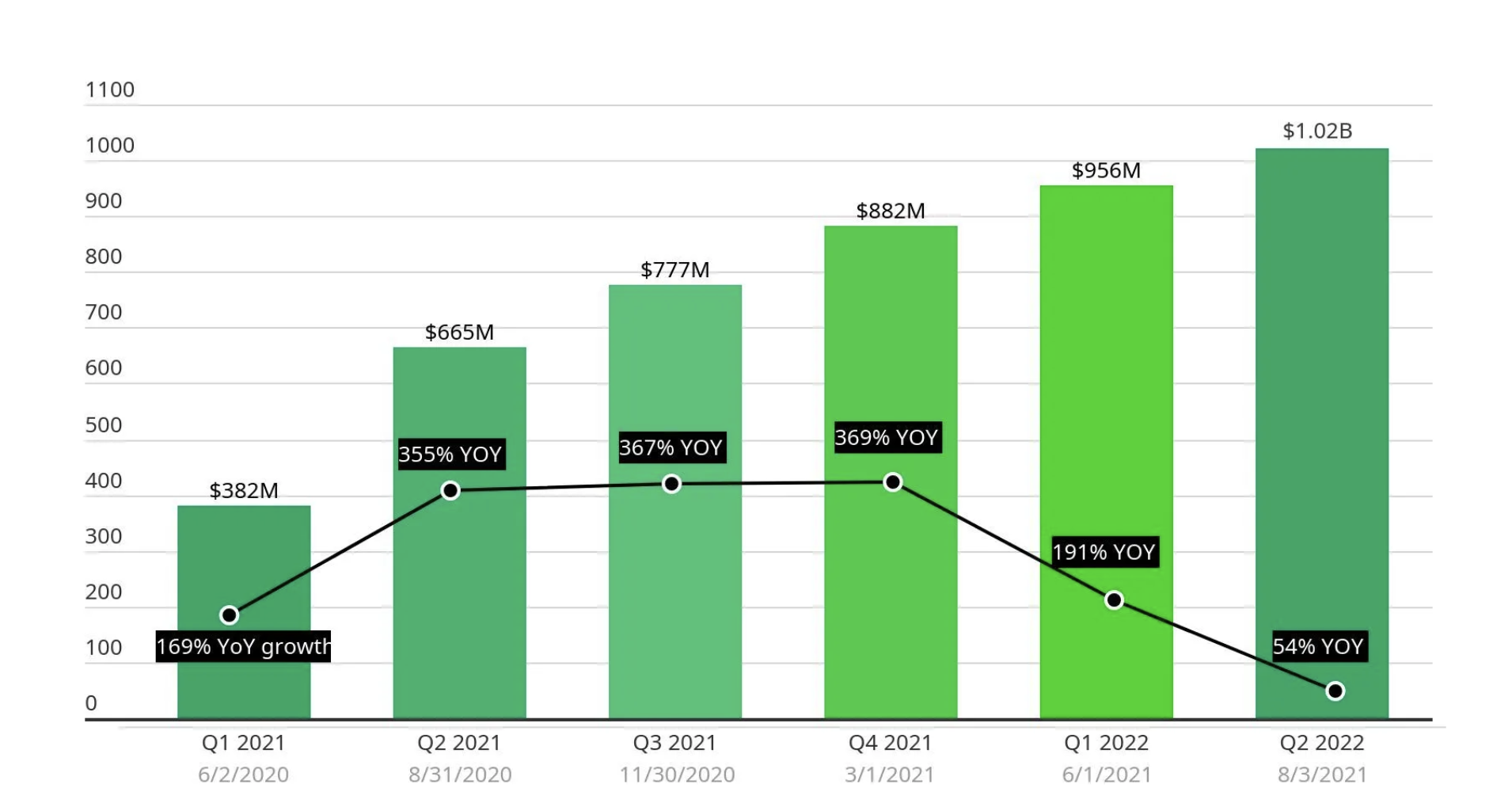
Zoom pandemic-fueled 3-digit growth from Q1 2021 to Q2 2022 before it began to drop off

Zoom pandemic fueled growth. Image Credits: TechCrunch

Today, even double-digit growth is long gone. For its most recent report earlier this month, the company reported revenue of $1.138 billion, up 3.6% over the prior year. That follows five straight quarters of single-digit growth, the last three in the low single digits.

Could Zoom possibly be a cautionary tale for a company like Nvidia riding the generative AI wave? And perhaps more importantly, will this drive unreasonable investor expectations about future performance as it did with Zoom?

Data center demand isn’t going anywhere

It’s interesting to note that Nvidia’s biggest growth area is in the data center, and that web scalers are still building at a rapid pace with plans to add over 300 new data centers in the coming years, per a Synergy Research report from March 2022.

“The future looks bright for hyperscale operators, with double-digit annual growth in total revenues supported in large part by cloud revenues that will be growing in the 20-30% per year range. This in turn will drive strong growth in capex generally and in data center spending specifically,” said John Dinsdale, a chief analyst at Synergy Research Group, in a statement about the report.

At least some percentage of this spending will surely be devoted to resources for running AI workloads, and Nvidia should benefit from that, CEO Jensen Huang told analysts on Wednesday. In fact, he believes that his company’s expansive growth is much more than a flash in the pan.

“There’s about $1 trillion worth of data centers, call it, a quarter of trillion dollars of capital spend each year. You’re seeing that data centers around the world are taking that capital spend and focusing it on the two most important trends of computing today: accelerated computing and generative AI,” Huang said. “And so I think this is not a near-term thing. This is a long-term industry transition, and we’re seeing these two platform shifts happening at the same time.”

If he’s right, perhaps the company can sustain this level of growth, but history suggests that what goes up must eventually come down.

Business gravity

If Zoom is any indication, some businesses that see rapid growth for one reason or another can hold onto that revenue in the future. While it’s certainly less exciting for investors that Zoom’s growth rate has sharply moderated in recent quarters, it’s also true that Zoom has continued to grow. That means it has retained all its prior scale and then some.


from TechCrunch
via Click me for Details

Tucker Carlson Tells Trump 'They' Need Him Dead

The first Republican presidential debate was last night, and Tucker Carlson's interview of Donald Trump was released minutes before the debate as counterprogramming. Surprisingly, the most deranged pronouncement in either event wasn't from one of the debaters (although Vivek Ramaswamy's assertion that "the climate agenda is a hoax" was extreme), nor was it anything Trump said. The most deranged pronouncement of the night was Carlson's assertion that an attempt on Trump's life is inevitable, because "they" need him dead -- which, according to Carlson, makes Trump like Jeffrey Epstein.

Slate's Molly Olmstead has the details:

In the interview ... former President Donald Trump was boasting about his poll numbers when Tucker Carlson suddenly cut him off.

“Can I ask you—that gets back to my original question,” he said. “If the protests didn’t work, and you got elected anyway; the impeachment didn’t work, twice; indictment is not working ... If you chart it out, it’s an escalation, is what I’m saying. So what’s next, after trying to put you in prison for the rest of your life? That’s not working. Don’t they have to kill you now?”

read more


from Latest articles from Crooks and Liars
via Click me for Details

Last chance to host an After Hours event at TechCrunch Disrupt 2023

Listen up, party people! You’re rapidly running out of time to host your own After Hours Event at TechCrunch Disrupt 2023, which runs September 19–21 in San Francisco. Build your brand, connect with your community and get your party started!

The application deadline is August 31 at 11:59 p.m. PDT. What are you waiting for? Consider this your final engraved invitation. We’ll even help promote your event for free!

Please note, we are AT CAPACITY for events on 9/20. We are still accepting all other dates.

Beat the deadline: Host an After Hours Event at TechCrunch Disrupt 2023

Apply to host an event of your own design and engage with more than 10,000 Disrupt attendees, as well as with your networks and the Bay Area tech community. You could host a happy hour, a career fair, a branded activity, a speaker panel or something completely different. Create an event specifically for Disrupt or submit an event you’ve already launched that is occurring during those days. It’s your After Hours party!

Get moving and submit your event for approval herebefore August 31 at 11:59 p.m. PDT. Approved After Hours events will receive free promotion across TechCrunch.com and the Disrupt 2023 website and will be promoted to Disrupt 2023 attendees through various channels like emails, posts and the event agenda.

It costs nothing to apply, and there’s no participation fee. Please note that hosts are responsible for managing all costs, promotions and operations associated with their event. You’ll find detailed instructions, planning information and the fine print in our After Hours Event Guide.

Don’t miss out on the After Hour events, not to mention the incredible Disrupt programming — including new industry-specific stages. Why wait? Buy your pass now, and you’ll save up to $400. Passes cost more at the door. Buy your pass now, and you’ll save up to $400. Passes cost more at the door. For a limited time, when you book your Disrupt hotel room at the Hyatt Regency San Francisco Downtown SOMA, you’ll automatically be eligible to enter a raffle for a chance to win two spots for you and a guest to attend the exclusive TechCrunch Disrupt Speakers & Editors Dinner. Book your room today. More hotel raffle details here.

Is your company interested in sponsoring or exhibiting at TechCrunch Disrupt 2023? Contact our sponsorship sales team by filling out this form.


from TechCrunch
via Click me for Details

Friend.tech hype grows, Tornado Cash founders go for a spin and FBI’s monitoring North Korean hackers

Welcome back to Chain Reaction.

To get a roundup of TechCrunch’s biggest and most important crypto stories delivered to your inbox every Thursday at 12 p.m. PT, subscribe here. Follow me on Twitter @Jacqmelinek for breaking crypto news, memes and more.

If you haven’t heard about friend.tech this week, you’re probably living under a rock. But that’s ok, we dove deep into the hype and looked at what skeptics are worried about for the new application.

There was also a lot of talk around Tornado Cash as the two founders behind the crypto mixer were charged on Wednesday by U.S. federal agencies. Details on that and more below.

This week in web3

  1. Two founders behind crypto mixer Tornado Cash charged by U.S. federal courts
  2. FBI says North Korean hackers preparing to cash out after high-profile crypto hacks
  3. Friend.tech hype is skyrocketing, but will it actually reach the stars?
  4. Solana Pay integrates plug-in with Shopify for USDC payments
  5. Checkout.com cuts ties with Binance, which is mulling legal action in response

The latest pod

For this week’s episode, Jacquelyn interviewed Erik Svenson, co-founder, president and chief financial officer at Blockstream, a bitcoin and blockchain-focused infrastructure firm.

The company was founded in 2014 and has its own sidechain technology, Liquid Network, as well as bitcoin mining operations and hardware wallets for Bitcoin and other assets. It most recently raised $125 million in January and has raised more than $400 million to date.

Erik previously worked on Wall Street as a VP for AIG investments and was a co-founder and consultant of other startups. The last startup he co-founded before Blockstream was Dan’s Plan, a health tech company.

We discussed how the current macroenvironment is impacting Bitcoin-focused businesses and where Erik sees the most opportunities for startups today.

We also talked about:

  • Blockstream’s mining operations
  • Surviving a bear market
  • Transitioning from TradFi to crypto
  • Advice for startups

Subscribe to Chain Reaction on Apple Podcasts, Spotify or your favorite pod platform to keep up with the latest episodes, and please leave us a review if you like what you hear!

Follow the money

  1. Crypto lender Maple Finance raises $5 million to enter Asia amid regulatory clarity
  2. Vessel Capital emerges from stealth with $55 million fund focused on web3 infrastructure and apps
  3. Berlin-based Anytype raises $13.4 million for its open sourced tool
  4. Nodal Power raises $13 million to use landfill to power bitcoin mining centers
  5. Decentralized credit protocol PADO Labs raises $3 million in a seed round

This list was compiled with information from Messari as well as TechCrunch’s own reporting.

What else we’re writing

Want to branch out from the world of web3? Here are some articles on TechCrunch that caught our attention this week.

  1. Nvidia’s Q2 earnings prove it’s the big winner in the generative AI boom
  2. 5 trends in VC funding for pre-seed startups (TC+)
  3. Chronic technical debt could be holding your company back (TC+)
  4. The late-stage venture market is crumbling (TC+)
  5. Introducing the Startup Battlefield 200 companies at TechCrunch Disrupt 2023


from TechCrunch
via Click me for Details

Wednesday, 23 August 2023

Jeanine Pirro Is Gonna Die Mad, Lying About Biden

I have to hold back when writing about Jeanine Pirro because I will start using gender-specific swear words that my husband says are beneath me.

Never forget that Donald Trump helped to fund Pirro's "campaign" for New York Attorney General, after she dropped out of the US Senate race against Hillary Clinton. Too bad Donnie's money wasn't quite enough to cover the $600,000 in campaign debt she accrued in FOUR MONTHS.

Trump spent part of his final minutes as president pardoning Jeanine's ex-husband, who was convicted of conspiracy and tax evasion in 2000.

So maybe she owes him a trail of screaming lies on the regular.

But the people of Hawaii deserve better because Jeanine is lying about them, too.

After flipping out about the admittedly horrible conditions in Maui, Jeanine picks up the soundbite of Biden with the dog that the entire right-wing has decided was the entirety of his visit (lie). Then she says this:

"He has a lack of empathy. He is egocentric. He’s got a condescending smirk whenever anybody asks him a question from the press. He’s lying and he’s narcissistic.”

read more


from Latest articles from Crooks and Liars
via Click me for Details

OMERS Ventures didn’t exit Europe because of the market — but it had good reason to

A few weeks ago, Bloomberg reported that OMERS Ventures, the venture capital firm backed by the Ontario Municipal Employees’ Retirement System, was calling it quits in Europe just four years after opening a London office, hiring a team and setting aside $332 million to invest in the region.

At the outset, it may seem as if the lackluster state of the European venture market may have motivated the exit, but it appears that wasn’t the case. Instead, OMERS’ exit was rather due to logistics related to being a solo LP operation, a source familiar with the matter told TechCrunch+.

OMERS Ventures did not immediately respond to requests for comment.

Even though OMERS didn’t leave because of how things are in Europe right now, it wouldn’t have been that surprising if it did. The startup ecosystem in Europe doesn’t look that great at the moment, with lower deal and exit activity than the U.S., which itself is struggling.

Europe had only 1,332 deals in the first half of 2023, marking a decrease of 34.2% from the second half of 2022 and a decline of 60.8% compared to the same period a year earlier, according to PitchBook. The U.S. is the world’s biggest startup market at the moment, but the difference in deal count and activity is stark, even accounting for the general slowdown: The U.S. had 6,514 deals close in the first half of 2023.

European startups also seem to be finding it hard to exit, or are at least unable to land deals at valuations they might like. Through the first half of this year, startup exits only generated €3.5 billion ($3.8 billion) in total. If things don’t improve soon, the European market will not be able to surpass, or even match, the exit volume of any year from the last decade.

Investors from elsewhere in the world seem less interested, too. U.S. investors participated in 746 deals in Europe in the first half of 2023. compared to 1,704 a year earlier, according to PitchBook data. Given how much U.S. investors have pulled back from the region, OMERS wouldn’t have been out of place had it done so because of market conditions.


from TechCrunch
via Click me for Details

SpaceX alums say they’ll bring rocket reliability to EV charging

Electric Era says it cracked the code for fast and reliable electric-vehicle charging stations that can go wherever they’re needed.

Founded by former SpaceX engineers, the startup just announced a $11.5 million series A round led by HSBC’s asset management arm. Climate-tech fund Blackhorn, lithium-mining giant SQM and mobility-focused investor Proeza also chipped in.

Electric Era intends to use that cash to prove that its soon-to-launch PowerNode stations can help turn around public chargers’ wack reputation in the U.S. It’s a worthwhile goal, since subpar and scarce public chargers, as well as grid infrastructure challenges, are altogether slowing down EV adoption in the U.S. — hampering the nation’s decarbonization plans. But is four-year-old Electric Era up for the challenge?

Founder and CEO Quincy Lee tells TechCrunch that the team’s experience developing Starlink satellites in particular will help make it happen. Lee worked at SpaceX for seven years, while CTO Sam Reineman spent nine years and software VP Sith Dharmasiri spent seven at the Elon Musk-cofounded private space company. Lee argues that their prior experience there grants Electric Era both an outsider’s perspective and deep technical engineering competencies. “We’ve really gone from space down to earth and are working on building the infrastructural backbone that EV drivers need,” added Lee.

Electric Era is developing its own software — PowerNode OS — and some hardware, while outsourcing other key components. “We don’t build the chargers or the batteries,” said Lee. “We focus instead on the entire EV fast charging station.” The CEO says the startup’s “battery-backed and software optimized” PowerNode stations bring a “rocketry level of reliability” to public EV charging, without requiring serious grid upgrades.

These stations can apparently scale up gradually, wherever they’re needed, such as gas stations, convenience stores, grocers and restaurants. “We can, as part of our software stack, incorporate real-time management of battery systems and solar systems to bring energy and generation to the sites, so that we can add more capacity to the grid locally, as opposed to kind of redoing all the wires,” said Lee.

As for where you can find a PowerNode station, the company plans to launch in nine states before the end of the year. That’ll be about 27 chargers in total, or about three per station, Lee tells TechCrunch.

Lee says the startup’s thesis is that “legacy car refill is dying. They’re facing extinction from this shift to electric forms of transportation, and we are keeping them in business.” Electric Era handles everything from real-time monitoring to on-site energy management. That’s one factor in the company’s plan to keep reliability high. Another is extensive testing, which includes running these power-management systems through “a ton of different crazy edge cases” and charging 20-30 different types of vehicles — Teslas, Rivians, Bolts, Leafs and so on.

The company is on a “warpath to have about three gigawatt hours of installed battery capacity and utilities all across the country by 2030,” according to Lee. That’d equate to operating about 10,000 stations across the U.S. — a serious undertaking, but not all that huge a figure if you consider that S&P analysts expect to see 28 million EVs on U.S. roads by the end of the decade.

Electric Era has raised $19 million to date, and its series A values the firm at $48 million (post money).


from TechCrunch
via Click me for Details