It’s difficult to determine why Kentucky Sen. Rand Paul, a Duke University School of Medicine grad, believed that legal voting by Democrats somehow equated to stealing elections, but according to a recent tweet by the senator, that’s exactly what he thought.
Good thing that wasn’t on a test to become a senator. Fail!
Referring to an article published in the uber-conservative Washington Examiner, Paul accused Democrats of “stealing” elections by persuading people to vote for them—of course, that is exactly how democracy works last time we checked.
Paul’s tweet read: “How to steal an election: ‘Seeding an area heavy with potential Democratic votes with as many absentee ballots as possible, targeting and convincing potential voters to complete them in a legally valid way, and then harvesting and counting the results.’”
How to steal an election: “Seeding an area heavy with potential Democratic votes with as many absentee ballots as possible, targeting and convincing potential voters to complete them in a legally valid way, and then harvesting and counting the results.”https://t.co/LwE3MdeWeG
Koko Networks, a Kenya-based bio-fuel technology enterprise has extended its business to cover other fast-moving consumer goods, through a new tech platform that will capitalize on its established distribution networks in low-income neighborhoods.
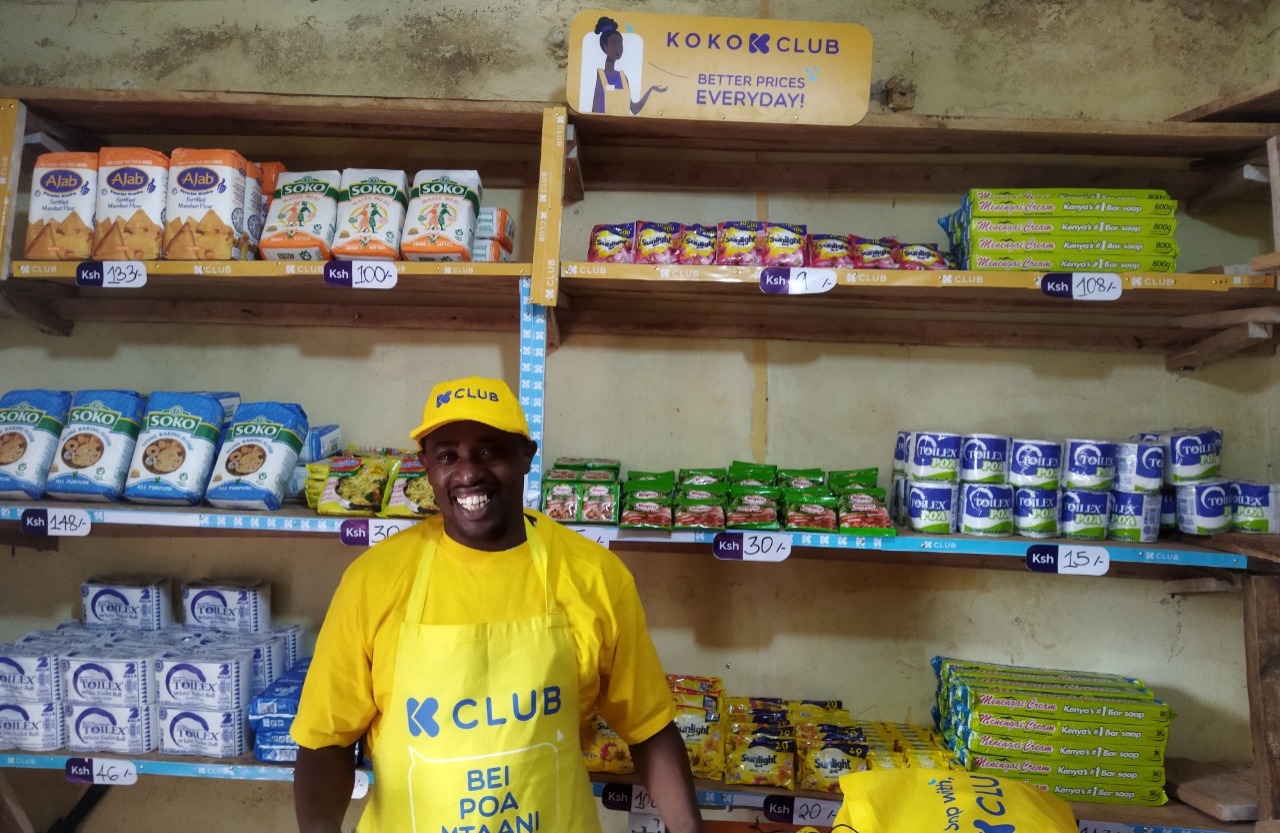
Koko Club, its new business-line, will sell the products directly to consumers through the dukas (small shops) that currently serve as the company’s agents for its bio-ethanol cooking fuel and stoves.
The Koko Club products, which will be displayed in designated spaces within the agents’ small shops, will only be sold to registered Koko Club members.
The shop owners (agents) will use Koko’s PoS system to sign up customers, capturing their biodata, and issuing them with an electronic card that they will use when buying products from any Koko Club shop.
The cards will be linked to an e-wallet, similar to the one currently used to purchase Koko’s bio-fuel, and which can be topped up via mobile money and other technologies.
Koko Club will source products directly from manufacturers and manage the inventory through a real-time management system that prevents stock-outs, in addition to providing accurate market analytics.
With 35 SKUs under its portfolio, initially, Koko Club will keep the prices of its products competitive by shortening the supply chains from manufacturer to consumers.
“We are targeting low-income households by bringing them the benefits of better products, lower prices and convenience. This is in addition to making sure that we have the right assortment of products all the time,” Koko Networks co-founder and chief innovation officer Sagun Saxena told TechCrunch. Grey Murray is the startup’s other co-founder and CEO.
Koko Club is a technology enabled retail platform targeting consumers in the low-income neighborhoods. Image Credits: Koko Networks
Micro-retail outlets, which account for 80% of sub-Saharan Africa’s household retail trade, are important for supplying consumers with groceries and other household items.
These informal retailers are usually located within a walking distance making them convenient to shoppers, with the added advantage of extending credit lines to loyal buyers.
These shops, however, continually suffer challenges like stockouts, variability in earnings, and inadequate financing making it hard for them to grow.
These are some of the gaps that Koko Club is planning to bridge, especially on the issue of stockouts — seeing that the agents do not require capital to restock.
Modernizing informal trade is regarded as one of the strategies for unlocking credit and the potential of these small micro-retail outlets as well as improving the lives of small business owners. Saxena said Koko Club’s business model gives manufacturers direct access to this market segment.
“Many of these manufacturers have armies of people that go into the neighborhoods to make sure that their products are being positioned properly and that these shops are styled. They even need to have people out there to figure out what prices the retailers are selling at,” he said.
“So, we take care of so much of that for them; we can tell them right now, exactly how many of their products are there and their price tags, and all that kind of information.”
The Koko Club idea was conceived mid 2020 but it wasn’t until the beginning of this year that the startup moved forward with its launch, riding on the success of its bioethanol fuel business, which was unveiled in 2019 as a cleaner, cheaper and safer alternative to charcoal and fuelwood.
Currently, there are over 300,000 households using Koko’s bioethanol fuel and stove (made in Koko’s plant in India) from about 100,000 in March this year. These households are served by the over 1,000 agents, who will now double up as Koko Club agents.
The Koko fuel business has in just over two years grown beyond Kenya’s capital Nairobi following a recent launch in the coastal city of Mombasa, with plans to enter Nakuru and Kisumu in the first half of 2022.
For the last two years, many of us have only been able to see our elderly relatives through screens, watching them grow older, trading physical distance for their safety. More than anything else, the pandemic has highlighted the vulnerabilities of aging people. The tech community—founders, investors, journalists—all need to pay more attention to “age-tech.”
“Age-tech” isn’t a niche sector, and aging populations aren’t limited to a few countries. According to a recent World Health Organization report, 1 in 6 people will be aged 60 years or over by 2030, while the number of people aged 80 years or over is expected to triple between 2020 and 2050 to 426 million.
“While this shift in distribution of a country’s population toward older ages—known as population aging—started in high-income countries (for example Japan 30% of the population is already over 60 years old), it is now low- and middle-income countries that are experiencing the greatest change,” the report said. “By 2050, two-thirds of the world’s population over 60 years will live in low- to middle-income countries.”
The WHO report goes on to say “globalization, technological developments (e.g., in transport and communication), urbanization, migration and changing gender norms are influencing the lives of older people in direct and indirect ways. A public health response must take stock of these current and projected trends and frame policies accordingly.”
Tech giants have started tapping into the potential of this growing demographic, creating new services for their existing platforms and hardware. For example, earlier this month, Amazon officially launched Alexa Together, which turns Alexa devices into tools for caregivers with features that allow users to call out for help, an emergency helpline, fall detection, a remote assist option to help manage device settings and an activity feed so family members can see if someone has been less active than usual. Google, meanwhile, started piloting a simplified Nest Hub Max interface last year at retirement homes in an effort to help residents feel less isolated during lockdowns.
What I find more interesting, however, are startups that focus on age-tech. When I cover hardware events, it’s heartening to see the number of companies developing tech for aging people. Most of next week’s CES announcements are still embargoed, but I’ll be doing a round-up of age-tech startups at the event.
At the last CES in January 2021, one of the most interesting products was Nobi’s smart lamp, an unobtrusive ceiling lamp that alerts caregivers when a fall or irregular movements are detected and automatically illuminates the floor when someone stands up to walk.
There were also several age-tech presentations, including one by AARP Innovation Lab, the nonprofit’s startup accelerator program, which presented nine companies. Many focused on helping elderly people “age in place,” or stay in their homes instead of moving into nursing facilities. These include Wheel Pad, whose accessible, modular work and home spaces fit into existing structures and sites; Zibrio, a scale that can be used at-home to predict if users are at a risk for fall; and FallCall Solutions, that develops Apple Watch apps and wearables, including jewelry, to help family members and other caregivers check in on users.
But hardware can only go so far. Startups around the world are looking at the needs of caregivers, too. Caregiver burnout is a major problem, but technology can help. For example, Homage, operational in Singapore and Malaysia, plans to expand into five more countries over the next two years. To assess caregivers and help match them with patients, it builds a profile of each provider and also works with nurses to evaluate how they are able to perform essential tasks like manual transfer techniques. All that data is used by its matching engine, which makes the process of finding caregivers faster for families and patients.
Meanwhile in the United Kingdom, Birdie is building software tools to support care providers, including ones that reduce administrative costs and enable real-time carer check-ins and medication-related notifications. The startup’s goal is to offer more personalized and preventative care so adults can live in their homes for longer as they age.
Changing family structures mean elderly people around the world have become increasingly isolated, and that’s a hard problem for technology to fix. But Papa, an on-demand senior assistance and companionship platform, shows that addressing loneliness among the elderly can translate into a promising business model. The Miami-based startup, which currently operates in 27 states, announced last month that it had raised $150 million in Series D funding, led by SoftBank Vision Fund 2, just seven months after a $60 million Series C.
Everyone deserves to reach the end of their lives not only in safety, but also in comfort and with dignity, and tech can be part of the solution to changing social dynamics that means aging people are often far from loved ones. One of my New Year’s resolutions is to cover more age-tech startups for TechCrunch and if you know of one I should pay attention to, please email me at shu@techcrunch.com.
The Raiders weren't on every week like they are today so I mostly saw him in playoff games that were aired nationally or whenever they played the Jets. I am a Giants fan but I did love the battles between Joe Namath and Daryle Lamonica
His win-loss record of 103–32–7 is incredible. He also had to suffer through the immaculate reception by Franco Harris. Like I did.
Madden, as a color commentary analyst had an incredible impact on the sport and the audience.
And then there was the game from EA Sports that helped make football even more popular.
Hide your “Tony the Tiger”/”Eugene Levy” fan fiction — those phrases, along with hundreds of others, are now banned from Tumblr’s iOS app.
Now, any personal blog that flags itself as “mature” is not accessible on the iOS app — users will see a pop-up explaining that the content has been hidden because of “potentially suggestive or explicit content.” Tumblr also said that certain posts will be hidden in the search function and on user’s dashboards — which shows recommended posts, as well as content from the users they’re following.
“In order for us to remain in Apple’s App Store and for our Tumblr iOS app to be available, we needed to make changes that would help us be more compliant with their policies around sensitive content,” Tumblr wrote in a blog post.
Image Credits: Tumblr
Tumblr users developed an unofficial crowdsourced list of tags that the Tumblr app has banned on iOS in order to comply with these policies. Some of the banned tags make sense for a platform trying to scrub itself of sensitive content — “porn,” “drugs” and “sex” are banned, for instance. Others are incomprehensible (or troubling if you think about them for too long), like the aforementioned “Tony the Tiger” and “Eugene Levy.” Even tags with the numbers 69 and 420 are banned.
Many Tumblr users flock to the site to talk anonymously about their experiences, but some of these tag bans effectively censor those conversations. Several tags related to stimming, a common coping practice for autistic people, are banned, along with tags like “depression,” “PTSD” and “bipolar.”
“We understand that these adjustments will impact how users are able to access potentially sensitive content while using our iOS app, and that can be frustrating,” a Tumblr spokesperson told TechCrunch. “We are working on more thoughtful solutions which will be rolled out in the near future and we will keep the community updated as that work continues.”
A former Tumblr iOS engineer who blogs on the site as sreegs explained what might be causing this problem and its ineffective, bandaid-like solutions.
“If a reviewer [at Apple] runs your app and finds porn, your app is rejected and you’re told to correct the problem,” they wrote in a blog post. The engineer said that this would happen about “once every five updates,” but once the offending post — provided to Tumblr via screenshot — was removed, the app would be good to go.
“Once in a while Tumblr would get a really persistent reviewer. It would take a handful of porn scrubs and re-submissions before they’d finally green-light an update,” sreegs wrote. The engineer thinks that this is similar to what’s happening on Tumblr’s iOS app now.
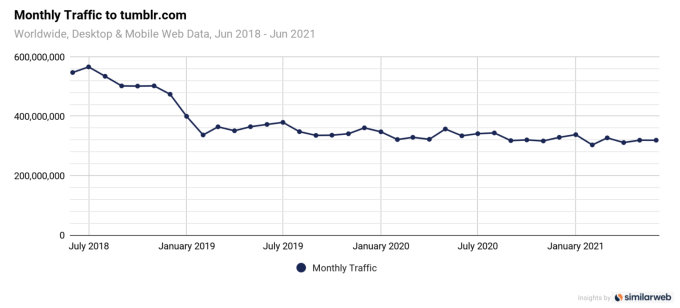
Tumblr has faced a years-long struggle with approval on the iOS App Store. In 2018, Tumblr’s iOS app was taken down from the App Store after child sexual abuse material (CSAM) made its way through the app’s filtering technology. A month later, the platform reacted by banning all porn and other sexually explicit content, resulting in a near-immediate 29% monthly traffic decrease. Since then, the platform’s web traffic has remained relatively stagnant.
Image Credits: SimilarWeb
Of course, it’s a Sisyphean task to scrub a user-generated content platform of any adult content. But Apple’s standards for Tumblr seem particularly stringent.
“A little part of me also wants to be cynical and say that since Instagram and Twitter are so big, they can get away with more than Tumblr can,” the former Tumblr iOS engineer theorized. “Combine that with Tumblr’s history of blatantly allowing porn up until the end of 2018. I can’t prove it, of course, but if Tumblr has a reputation at Apple, it can’t be a good one.”
In the meantime, Tumblr content is being banned tag by tag, from #rule 34 to #long post.
Tumblr wrote on its Changes blog yesterday that it’s reviewing the list of tags that can’t be accessed in the iOS app, and it expects this review process to pick up in January.
“We’re working on a web-based toggle that would allow folks to opt into allowing sensitive content in the iOS app,” it added.
Tumblr users often refer to the platform as a wasteland of the internet. The app itself once subtitled its iOS app as “hellsite (affectionate)” in the App Store. So why do people keep using it?
“We’re busted enough that people assume the site is dead, so stuff like this has super easy workarounds,” a dedicated Tumblrite told TechCrunch. It’s not hard to find these workarounds if you search “tag ban,” on the site, but regular users know that the search function is very buggy anyway.“I bet the broken search feature is actually coming in clutch here. Shit just doesn’t show up half the time, which means we can’t find it, but neither can Apple.”
But what Tumblr lacks in working iOS apps and search functions, it makes up for with its algorithm… or lack thereof. As platforms like TikTok, Twitter, YouTube, Facebook and Instagram face the Senate to talk about the mysterious ways they serve content, Tumblr is making it work (define “work”) the old-fashioned way. It displays content from users you follow in reverse chronological order.
“I honestly believe being a dumpster fire has fully worked in Tumblr’s favor at this point,” the avid Tumblr user said. “We’ve got no algorithm, so we still get to curate our experience exactly how we want.”
A fervent Italian anti-vaxxer who gained a cult following after his regular phone-ins to a popular radio show has died from Covid.
Maurizio Buratti, 61, known to his fans as Mauro from Mantua, had boasted of being a ‘plague spreader’ after deliberately going to a Carrefour supermarket without a mask while feeling ill and having a temperature of 38 degrees, just days before his hospitalisation.
He said he was ‘defending the constitution by ignoring public health advice, and refused to get tested because he believed the swabs caused the virus.
Buratti, who worked as a mechanic, had been in intensive care for 22 days before his death on Monday.
The show's presenter, David Parenzo, had this to say about his frequent guest:
‘Rest in peace wherever you are, old conspiracy theorist.
‘I only hope your sad story serves as an example to all those who are still fuelling doubts about the efficacy of vaccines.’
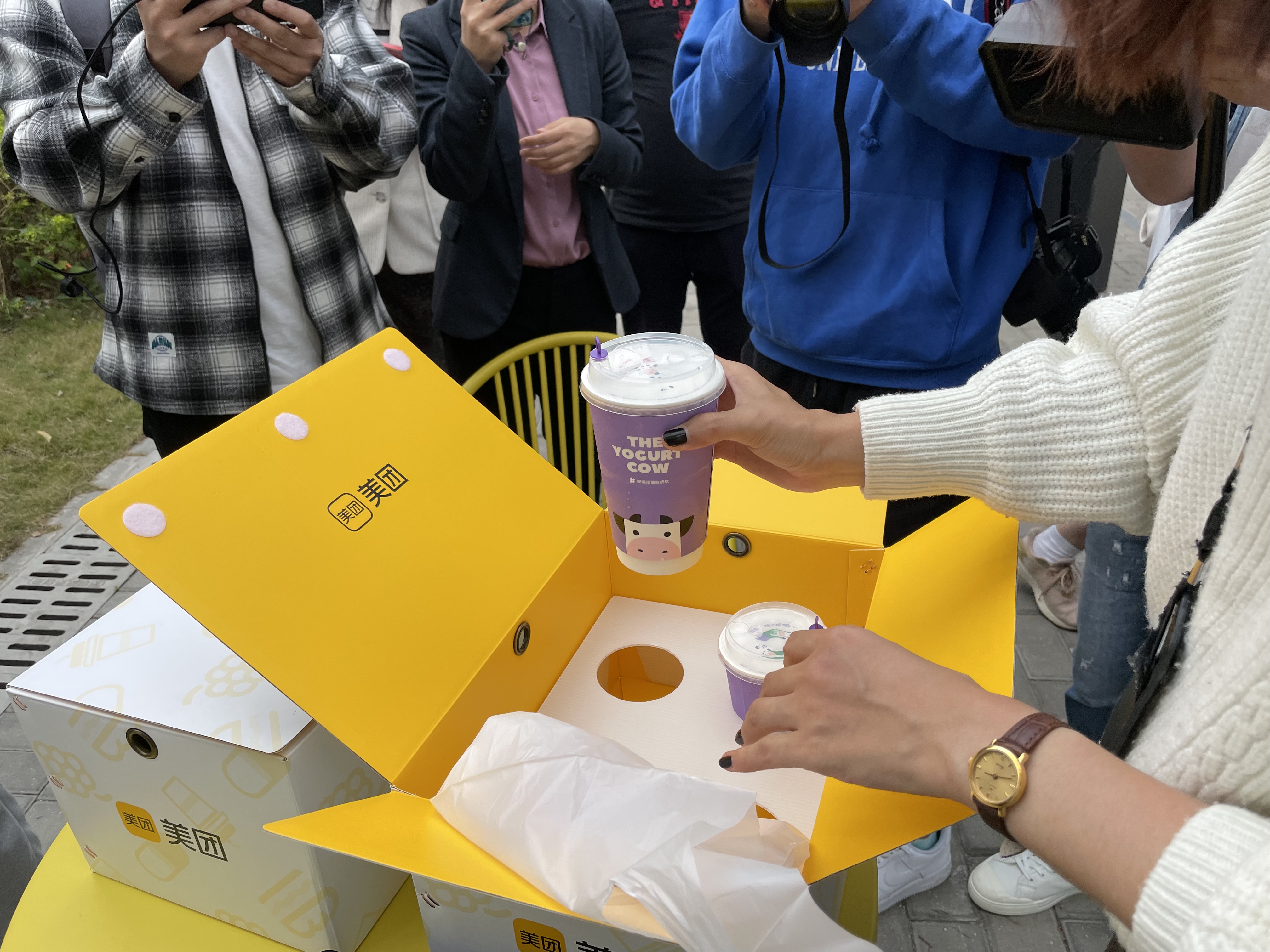
On a congested sidewalk next to a busy mall in Shenzhen, a 20-something woman uses a smartphone app to order a milk tea on Meituan, a major food delivery company. In under ten minutes, the pearl-white drink arrives, not on the back of one of the city’s ubiquitous delivery bikes, but descending from the cloudy heavens, in a cardboard box on the back of a drone, into a small roadside kiosk. The only thing the scene is missing is a choir of angels.
Over the past two years, Meituan, one of China’s largest internet companies, has flown 19,000 meals to 8,000 customers across Shenzhen, a city with close to 20 million people. The pilot program is available to just seven neighborhoods, each with a three-kilometer stretch, and only from a select number of merchants. The drones deliver to designated streetside kiosks rather than hover outside people’s windows as envisioned by sci-fi writers. But the trials are proof of concept for Meituan’s ambitions, and the company is now ready to ramp up its aerial delivery ambitions.
Tencent-backed Meituan isn’t the only Chinese tech giant that hopes to fill urban skies with tiny fliers. Alibaba, which runs Meituan’s rival Ele.me, and e-commerce powerhouse JD.com, have also invested in similar drone delivery services in recent years.
On the back of the pilot program, Meituan has applied to operate a commercial drone delivery service across all of Shenzhen, Mao Yinian, head of the company’s drone delivery unit, said at a press event this month. The application, submitted in September, is currently under review by Shenzhen’s aviation authority and is expected to receive approval in 2022, though the actual timeline is subject to government decisions.
“We went from experimenting in the suburbs to a central area. That means our operational capability has reached a new level,” said Chen Tianjian, technical expert at Meituan’s drone business, at the same event.
Meituan's self-developed drone just placed a milk tea order into its delivery station, from which the customer can pick up the drink using its app. Took 4 mins for the drone to arrive from the merchant 3km away. pic.twitter.com/F52lhLeowA
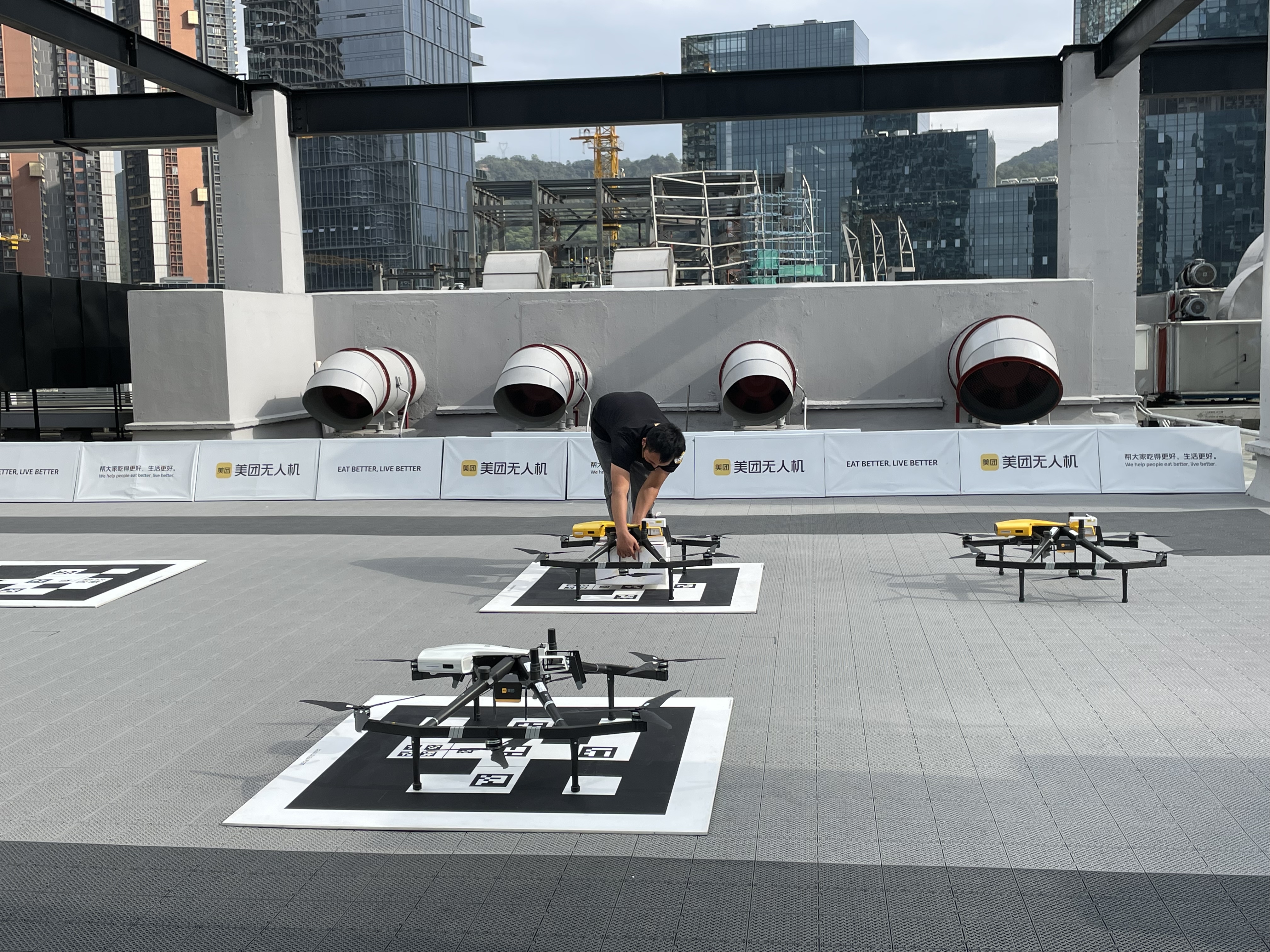
At the moment, Meituan’s delivery drones still involve a good amount of manpower. Take the milk tea order, for example. Once the drink is ready, Meituan’s backend dispatch system assigns a human courier to fetch it from the merchant in the mall to the roof of the complex, where the company has set up drone takeoff pads.
Meituan’s drone launching pads on the roof of a mall in Shenzhen / Photo: TechCrunch
Before takeoff, an inspector checks to see if the box holding the drink is secure. Meituan’s navigation system then calculates the quickest and safest route for the flyer to reach the pickup kiosk and off it goes, the milk tea into the sky.
The economic viability for using drones to deliver food of course is still unproven. Each of Meituan’s small aircraft, which are built with carbon fiber and weigh around 4 kilograms, can carry about 2.5 kilograms of food — roughly the weight of an average two-person meal, according to Chen. If someone orders just one cup of milk tea, the remaining space is wasted. Each kiosk can hold about 28 orders, so at peak hours, Meituan is betting on customers to gather their food promptly.
There’s also the matter of creating waste with the new delivery boxes. Meituan said it has set up recyclable bins next to the kiosks, but customers are also free to keep the containers. It won’t be surprised if some simply chuck them in the trash.
Lessons from the U.S.
From 2017 to 2018, China’s civil aviation authority started “following” the U.S. in light of research done by the Federal Aviation Administration on low-altitude aerial mobility, according to Chen. Not long after, the Chinese regulator began formulating guides and rules for this budding field. Meituan has similarly studied the paths of its American drone counterparts, but it realizes there isn’t a one-size-fits-all solution, as the two countries vary markedly in population density and consumer behavior.
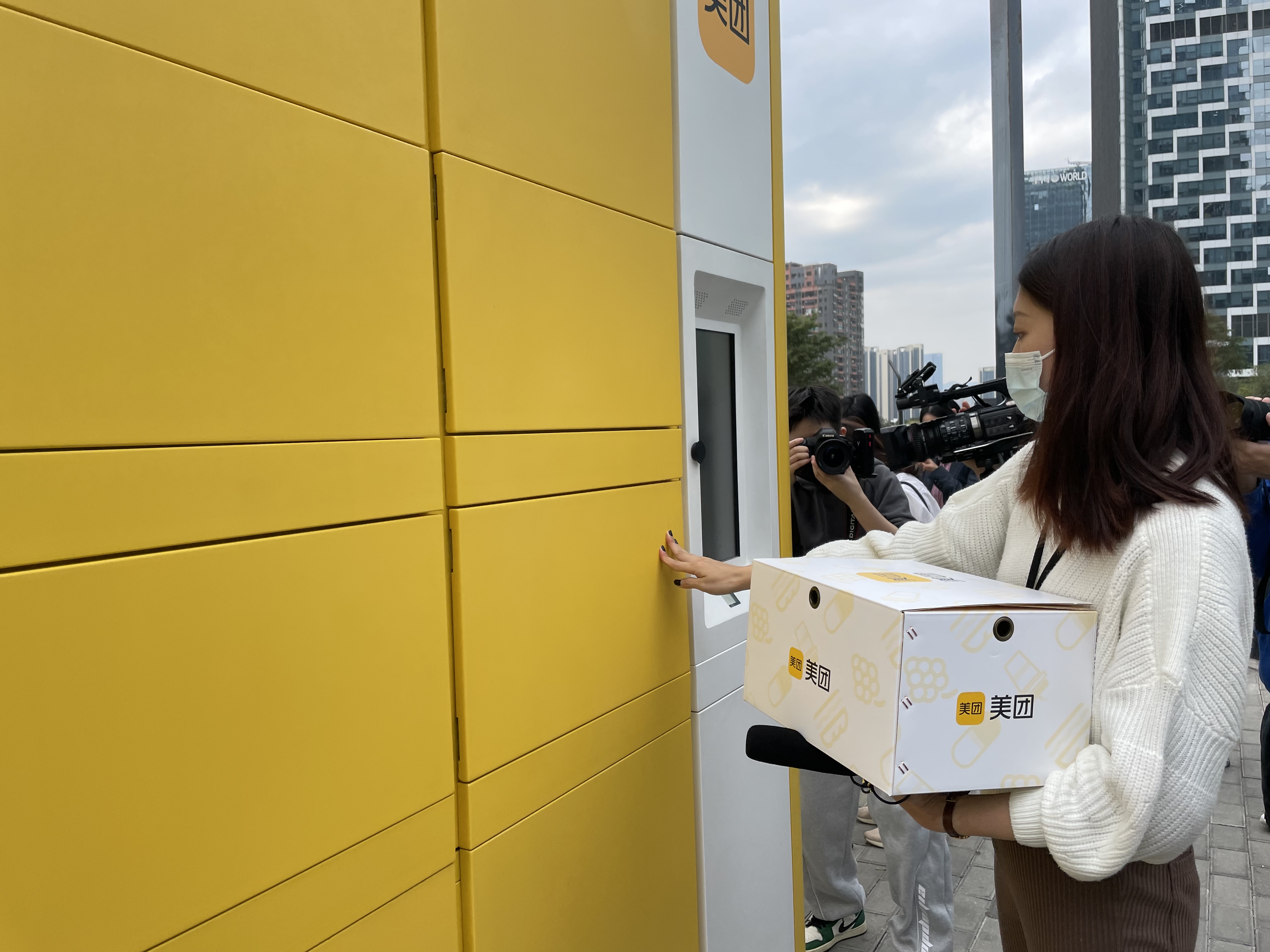
A customer picks up her order from Meituan’s drone landing kiosk in Shenzhen. / Photo: TechCrunch
Most Americans live in suburban sprawl, while in China and many other Asian countries, people are concentrated in urban clusters. As a result, drones in the U.S. are “focused more on endurance,” Chen said. Drones developed by Google and Amazon, for example, tend to be “fixed-winged with vertical landing and takeoff abilities,” while Meituan’s solution falls into the category of a small helicopter, which is more suited for complex urban environments.
Technologies emerging in the U.S. often offer useful clues to similar developments in China. The picture doesn’t look particularly rosy at Amazon Prime Air. The behemoth’s drone delivery business reportedly has been missing deadlines and laying off staff, though the firm said the unit continued to “make great strides.”
Prime Air, Chen argued, “doesn’t seem to have a clear strategy” and “has been vacillating between” neighborhood delivery, which is the focus of Alphabet’s Wing, and long-distance transport, which is UPS’s strong suit. He continued:
If you look at the competition between China and the U.S. in low-altitude aerial logistics, the important thing is to figure out one’s strategic position. Everyone can design a UVA. The question is what kind of UVA and for what customers.
Regulations
When asked about the safety of drone delivery, Chen said Meituan’s solution “strictly follows” the rules laid out by the “civil aviation authority.” The Beijing-headquartered company picked Shenzhen as its testing field not only because it’s home to drone giant DJI and a mature UAV supply chain. The southern metropolis, known for its economic experiments, also has some of the most friendly drone policies in China, the expert said.
Each of Meituan’s drones is registered with Shenzhen’s Unmanned Aircraft Traffic Management Information Service System (UATMISS). During flights, they are required to pin UATMISS with their precise locations every five seconds. More important, Meituan’s navigation system works to ensure the flyers avoid crowds and built-up areas on the ground, even at the cost of making detours.
The drones being piloted are Meituan’s third iteration on the model. They boast a noise level of about 50 decibels heard from a 15-meter distance, which is equivalent to “daytime street level,” according to Chen. The next generation will be even quieter with noise reduced to “nighttime street level.” But the small aircraft can’t be too quiet, as regulators have advised that having an acceptable level of noise “is safer.”
Human help
Meituan doesn’t plan to replace its millions of couriers in China with unmanned flyers outright, though automation would take some load off its overworked delivery platform. Its dispatch algorithms have come under criticism from both the public and the government for allegedly putting business performance business above rider safety. The challenge to recruit workers has already prompted labor-intensive industries to seek out robotic help.
Meituan’s goal is to find a sweet spot for human-robot collaboration. Shenzhen’s road infrastructure is notoriously unfriendly to scooter drivers and cyclists, but aerial travel isn’t restricted by such ground obstructions. Drones can fly over large interchanges and put meals at spots convenient for couriers to fetch and carry to customers’ final destination.
Meituan is already envisaging more automation. For instance, rather than having its staff manually swap depleted drone batteries, it has done R&D on automated battery swap stations. It’s also exploring a conveyor belt-like system that can move items from restaurants to drone takeoff pads nearby. These solutions are still years from large-scale deployment, but the food delivery titan is clearly gliding into an automated future.